
Investment Perspectives
The Value Before the Transaction
How the preliminary preparation of a significant real estate asset can influence price, timing, negotiated terms and risk
10 min readDream Generator

A significant property should not reach the market as a simple asset accompanied only by photographs, a description and an asking price.
Before a sale begins, it is necessary to understand what is actually being offered, which investors may be interested, which elements support its value and which issues could reduce that value during negotiations.
This work is the preliminary preparation of the asset.
It is not simply a promotional activity. It may include financial analysis, document review, the reconstruction of revenue and costs, the identification of suitable investors, an assessment of the works required, the preparation of a data room and the coordination of technical, legal and financial advisers.
The objective is to make the asset:
- understandable;
- verifiable;
- correctly positioned;
- easier to assess;
- less risky to acquire;
- more difficult to devalue during negotiations.
But how much can this work be worth in financial terms?
There is no percentage that applies to every property
It would not be correct to claim that preliminary preparation always increases the price by 5%, 10% or 15%.
Significant properties differ greatly from one another. A hotel, a historic building, a luxury residence and a property requiring conversion have different revenues, costs, risks and development potential.
International valuation standards treat valuation as a process that should be based on data, clearly stated assumptions, consistency and transparency. The International Valuation Standards Council emphasises the importance of consistency, comparability and transparency in valuation.
The correct question is therefore not:
By what percentage does preparation increase value?
The more useful question is:
What would probably have happened without preparation, and what can happen after the asset has been analysed, organised and positioned correctly?
The value of the service should be assessed by comparing these two situations.
Four different ways to produce value
Preliminary preparation can have four distinct effects.
1. Creating value
In some cases, the preliminary analysis identifies inefficiencies that can be corrected before the sale.
For example:
- excessive operating costs;
- outdated contracts;
- unused spaces;
- revenue that is not being fully developed;
- missing but obtainable authorisations;
- possible alternative uses;
- targeted works capable of improving profitability.
In these cases, preliminary work can produce a real financial improvement.
2. Making existing value visible
Sometimes value already exists, but it has not been demonstrated.
A property may have strong revenue, a strategic location or important development potential. If this information is not organised and documented, an investor may not recognise it or may attribute very little value to it.
Preparation therefore transforms a statement into a proposition that can be examined and verified.
3. Protecting value during negotiations
Incomplete information may allow a buyer to request a price reduction during the final stages of a transaction.
This can be particularly damaging when the seller has already invested time and money in the process and has stopped speaking to other potential buyers.
Preparing the asset means anticipating questions, identifying problems and reducing the opportunities for late-stage price reductions.
4. Avoiding the destruction of value
For the buyer, careful preliminary analysis can prevent an apparently attractive investment from producing unexpected costs after acquisition.
Possible problems include:
- works that were not included in the original budget;
- structural defects;
- planning restrictions;
- energy costs above expectations;
- missing authorisations;
- unfavourable contracts;
- unsustainable revenue;
- underestimated renovation times.
In these cases, the value of the service corresponds to the loss that has been avoided.
The value for the seller
The financial benefit for the seller can be expressed through a simple formula.
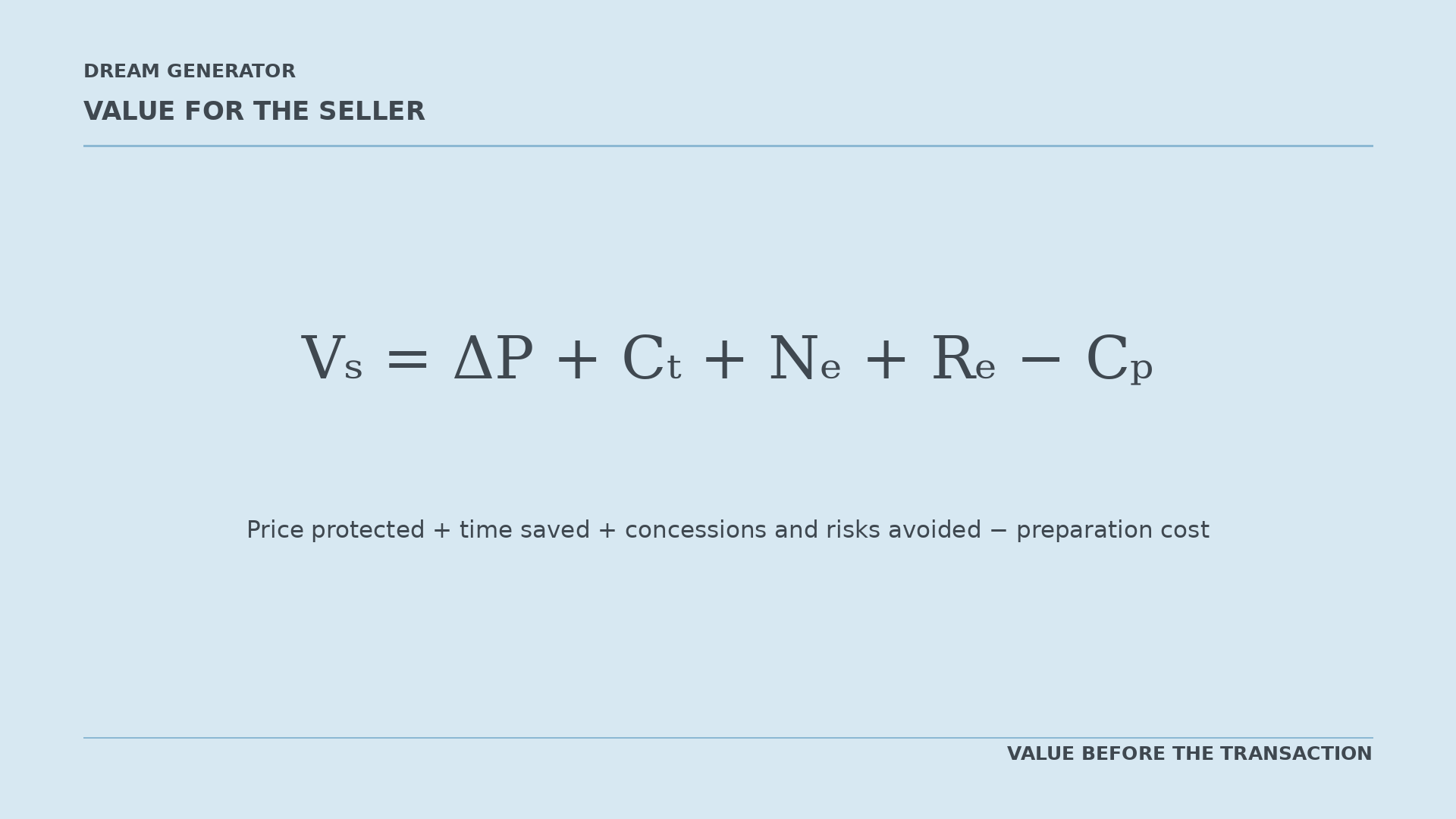
The symbols represent:
- VS
- the net value produced for the seller;
- ΔP
- the additional price achieved or protected;
- CT
- holding costs saved through a shorter sale process;
- NE
- negotiating concessions avoided;
- RE
- risks and costs of a failed transaction avoided;
- CP
- the cost of preparation and advice.
The formula does not promise a particular result. It simply provides a structure for identifying the different sources of financial value.
First example: operating income and property value
For an income-producing property, one of the most important measurements is NOI, meaning Net Operating Income.
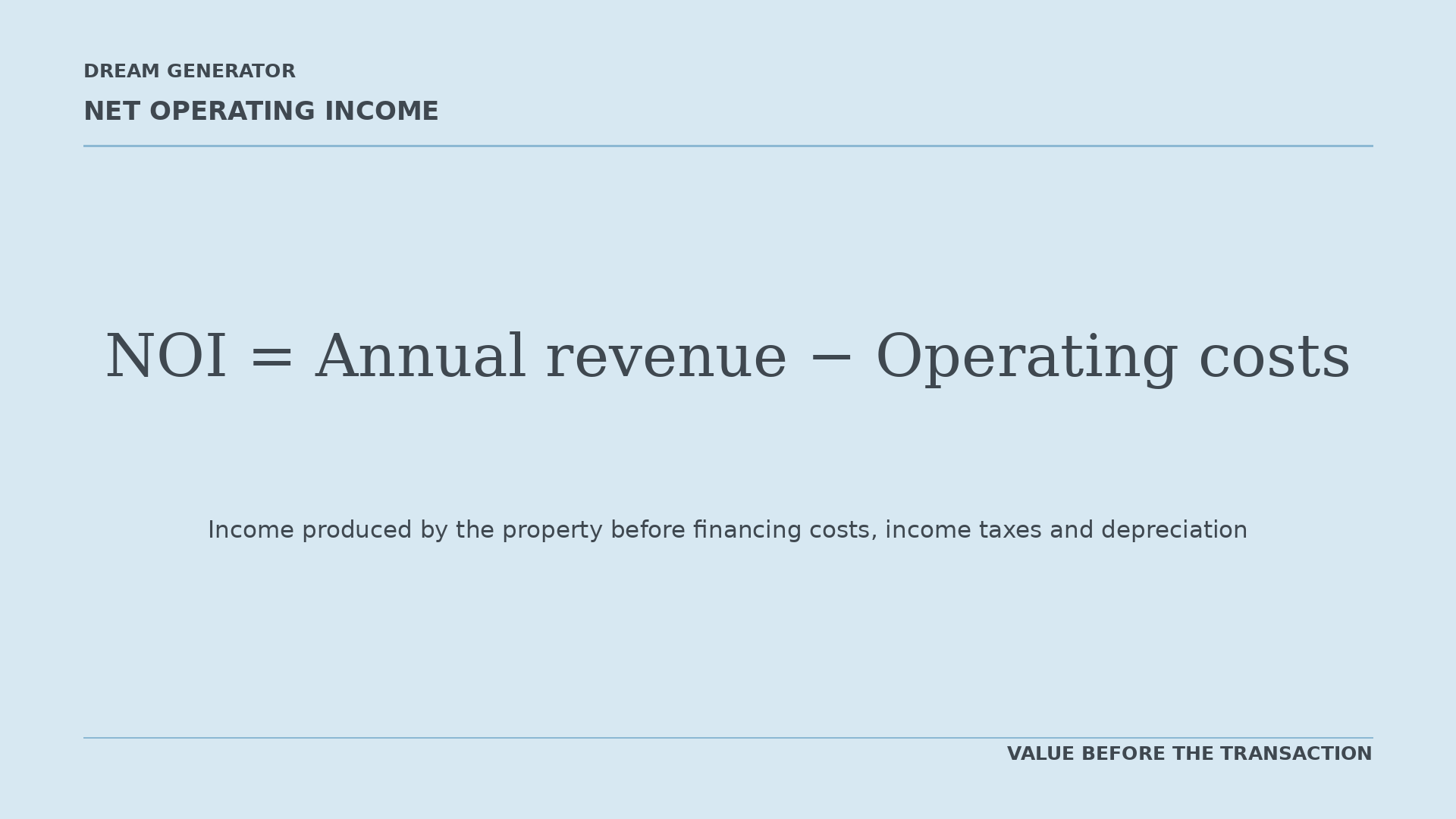
NOI is the annual income produced by the property after deducting its operating costs.
It does not normally include financing costs, income taxes or depreciation.
If a property produces annual revenue of €1,500,000 and has annual operating costs of €300,000, its NOI is:
€1,500,000 − €300,000 = €1,200,000
A simplified formula frequently used to estimate the value of an income-producing property is:
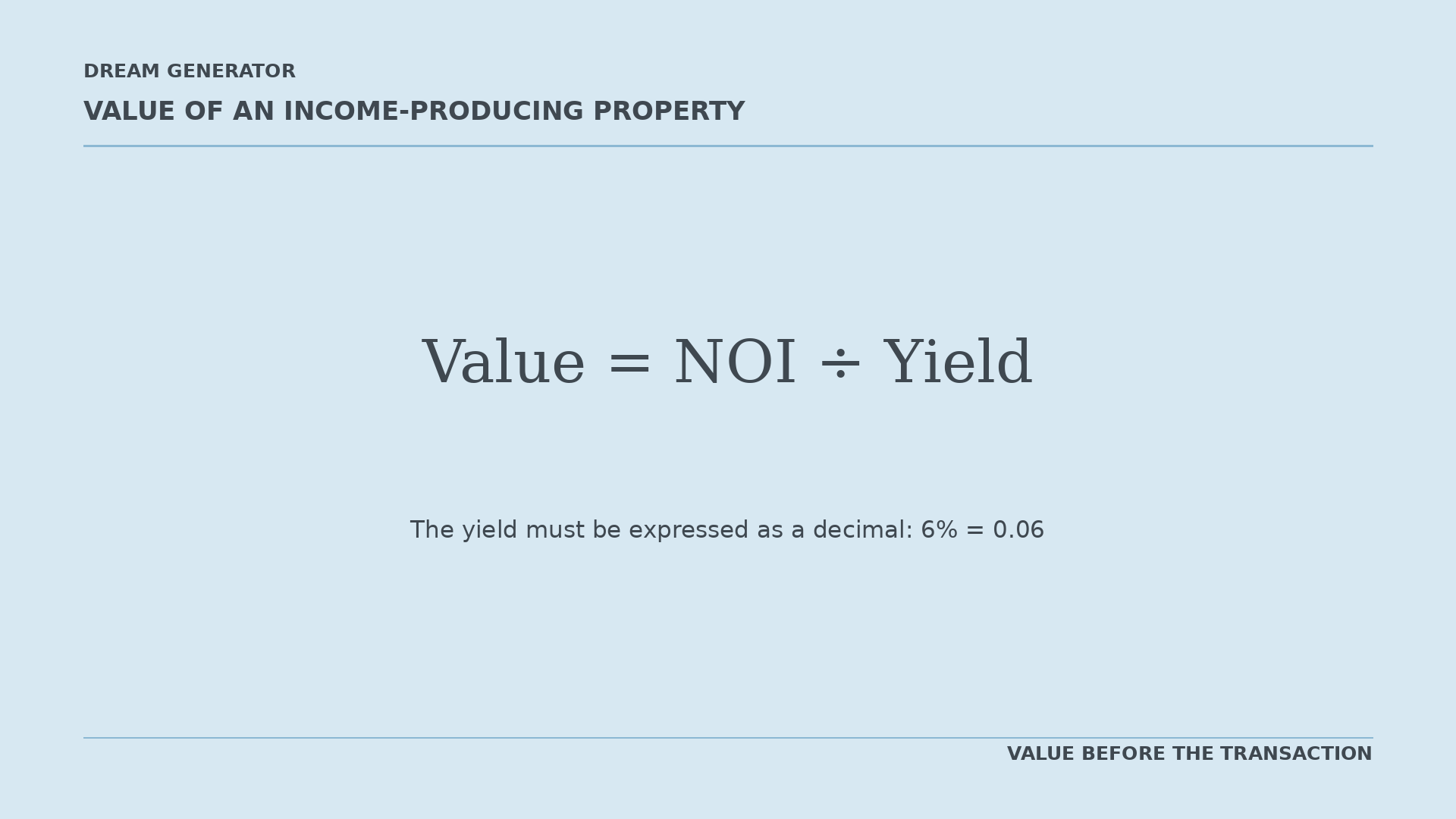
The yield must be written as a decimal. A yield of 6% therefore becomes 0.06.
Suppose a property produces NOI of €1,200,000 and the market requires a yield of 6%.
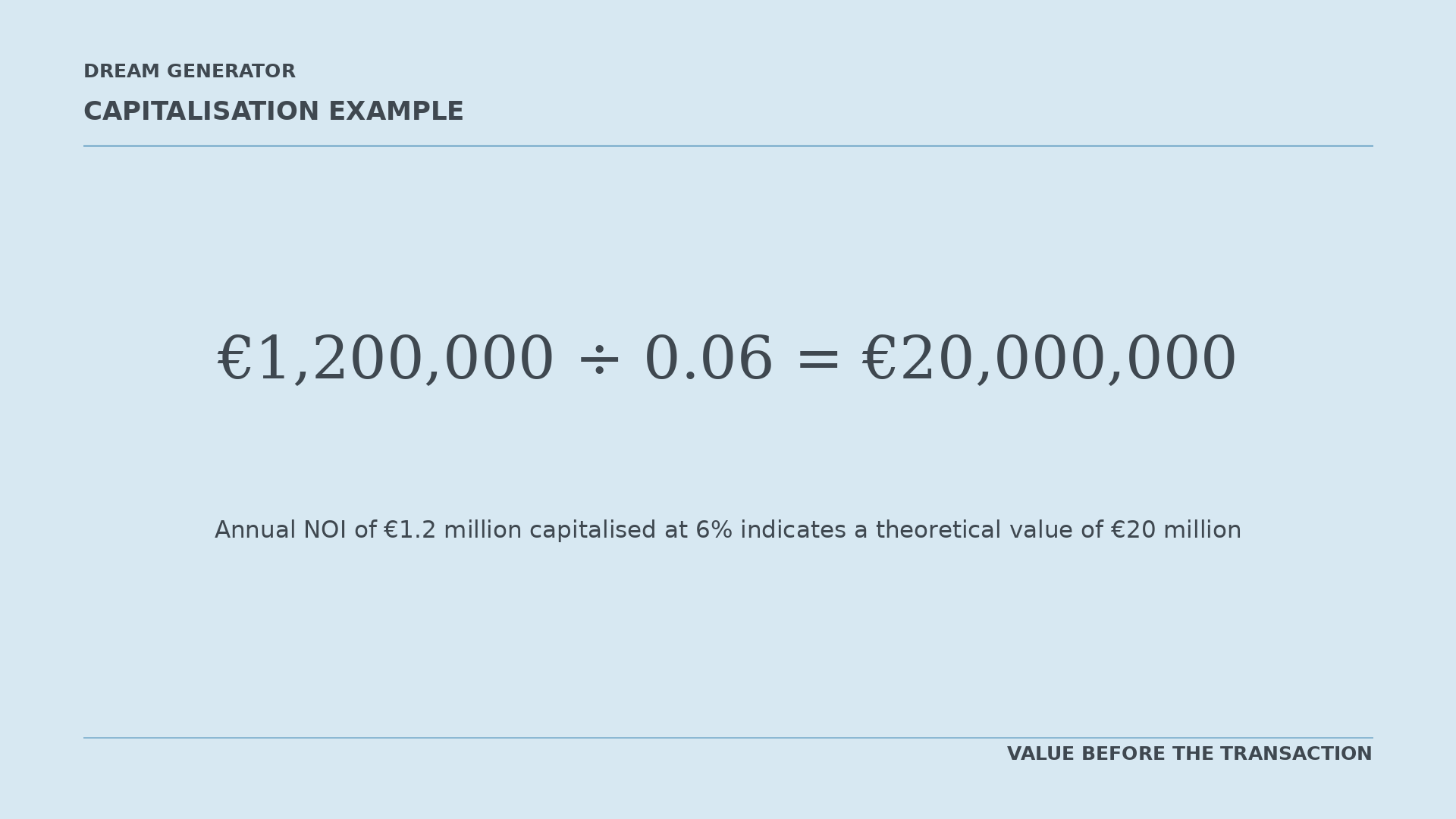
The theoretical value is therefore €20,000,000.
The relationship between income, yield and value is one of the basic principles used when analysing income-producing property.
What happens if NOI improves?
Imagine that the preliminary work identifies and implements a stable annual improvement in NOI of €100,000.
The new NOI would be:
€1,200,000 + €100,000 = €1,300,000
If the yield remains at 6%:
New value = €1,300,000 ÷ 0.06 = €21,666,667
The theoretical difference would be:
€21,666,667 − €20,000,000 = €1,666,667
This does not mean that the selling price will automatically rise by €1,666,667.
The additional income must be real, sustainable and documented. The market must also consider it reliable. The calculation simply demonstrates how even a relatively limited annual improvement may affect theoretical value.
| Stable annual improvement in NOI | Theoretical increase in value at 6% |
|---|---|
| €50,000 | €833,333 |
| €100,000 | €1,666,667 |
| €150,000 | €2,500,000 |
Second example: reducing perceived risk
Investors do not consider only how much income a property produces. They also consider the risk attached to that income.
Incomplete documents, uncertain contracts or works that are difficult to estimate may lead an investor to require a higher yield.
A higher yield produces a lower value when income remains unchanged.
Consider again the property with NOI of €1,200,000.
At a yield of 6%:
Value = €1,200,000 ÷ 0.06 = €20,000,000
If better information and lower perceived risk allowed the market to accept a yield of 5.75%:
Value = €1,200,000 ÷ 0.0575 = €20,869,565
The theoretical difference would be approximately:
€20,869,565 − €20,000,000 = €869,565
This is not a guaranteed result.
The yield depends on market conditions, location, property quality, contracts, liquidity and many other factors.
The example shows how sensitive value may be to the market’s perception of risk.
Third example: the cost of time
A longer sale does not involve only a longer wait. It also creates costs.
Suppose a property has debt of €10,000,000 with an annual interest rate of 5%.
The annual interest cost is:
€10,000,000 × 5% = €500,000
The monthly interest cost is:
€500,000 ÷ 12 = €41,667
If better preparation reduced the sale period by six months, the interest saving alone would be approximately:
€41,667 × 6 = €250,002
Now add management, insurance, maintenance, security and advisory costs of €25,000 per month:
€25,000 × 6 = €150,000
The total six-month saving would therefore be approximately:
€250,000 + €150,000 = €400,000
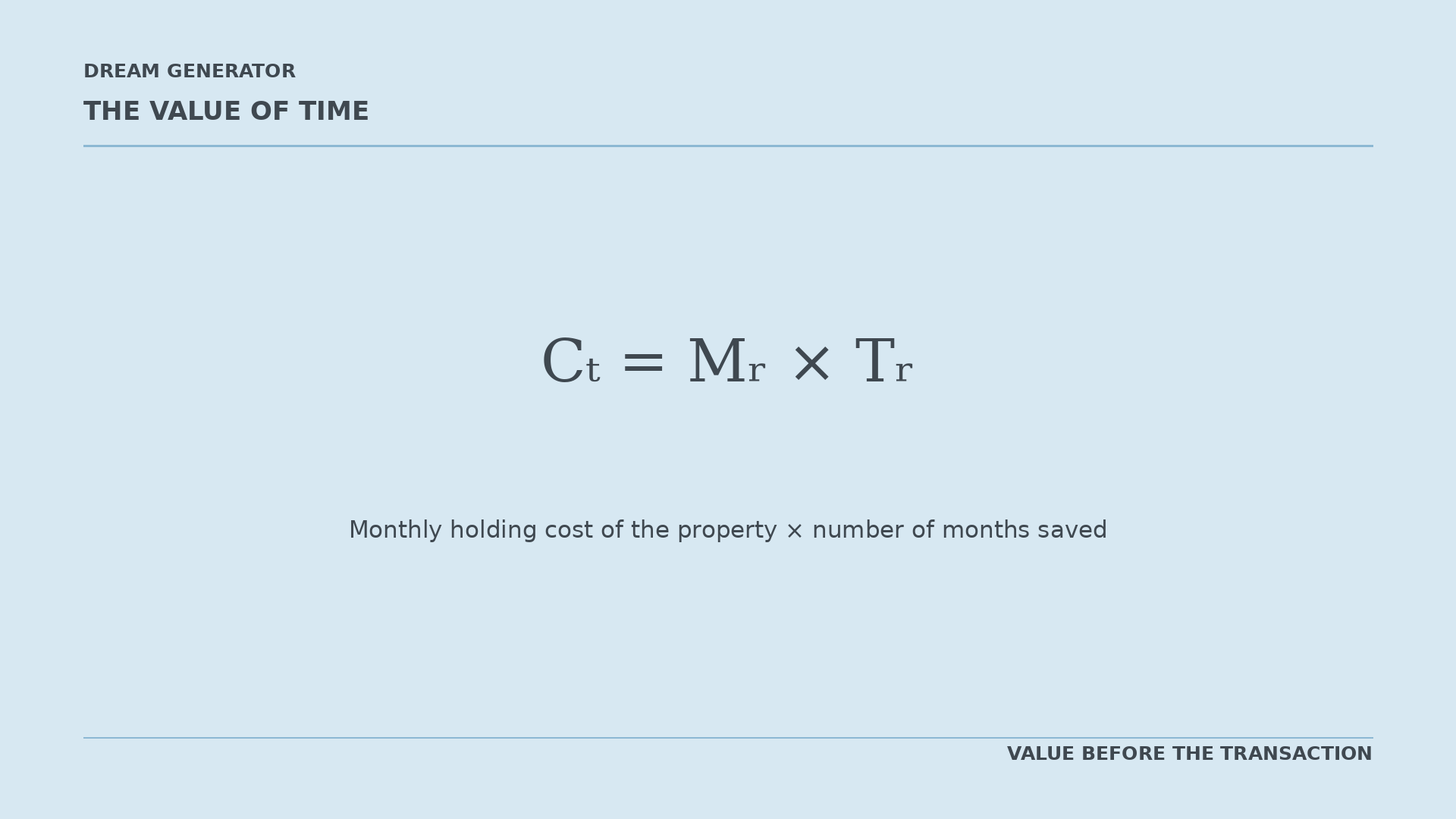
In this formula:
- CT
- is the holding cost saved;
- MR
- is the monthly holding cost of the property;
- TR
- is the number of months saved.
Fourth example: a price reduction during negotiations
Suppose the price agreed at the beginning of a transaction is €20,000,000.
During due diligence, missing information is discovered and the buyer requests a reduction of 5%:
€20,000,000 × 5% = €1,000,000
If better preparation had identified and managed those problems earlier, limiting the reduction to 2%, the concession would have been:
€20,000,000 × 2% = €400,000
The portion of the price protected would be:
€1,000,000 − €400,000 = €600,000
The preparation has not created €600,000 of new financial value. It has prevented part of the existing value from being lost during negotiations.
The value for the buyer
For the buyer, the value of preparation can be expressed through a second formula.
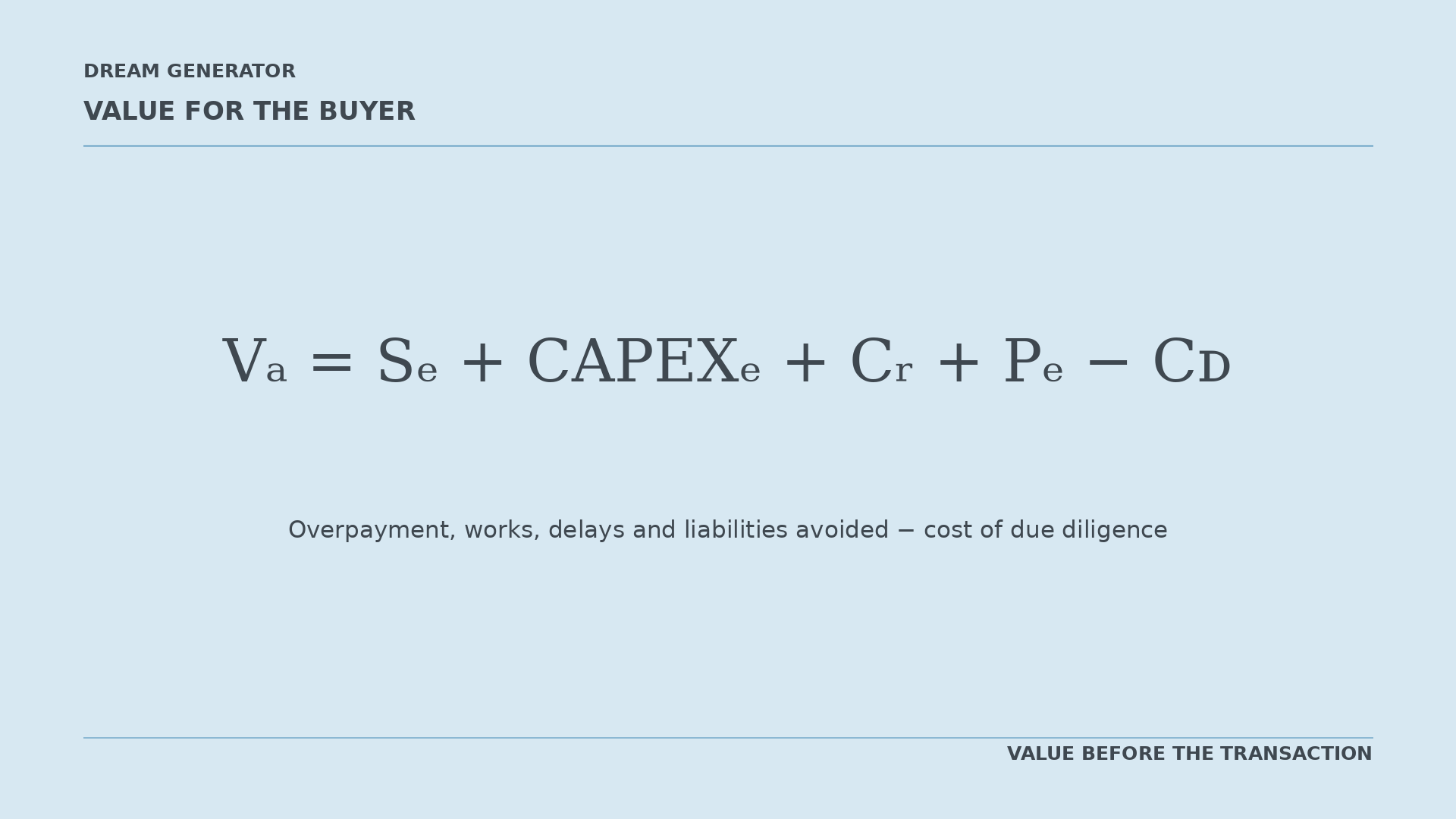
The symbols represent:
- VA
- the net value produced for the buyer;
- SE
- overpayment avoided;
- CAPEXE
- unexpected works avoided;
- CR
- costs of delays avoided;
- PE
- other losses or liabilities avoided;
- CD
- the cost of analysis and due diligence.
The term CAPEX refers to capital expenditure on works, installations, renovation and other long-term improvements to the property.
Turning risk into a number
A risk is not a certainty.
It can be estimated by multiplying:
- the probability that the problem will occur;
- the financial cost of the problem.
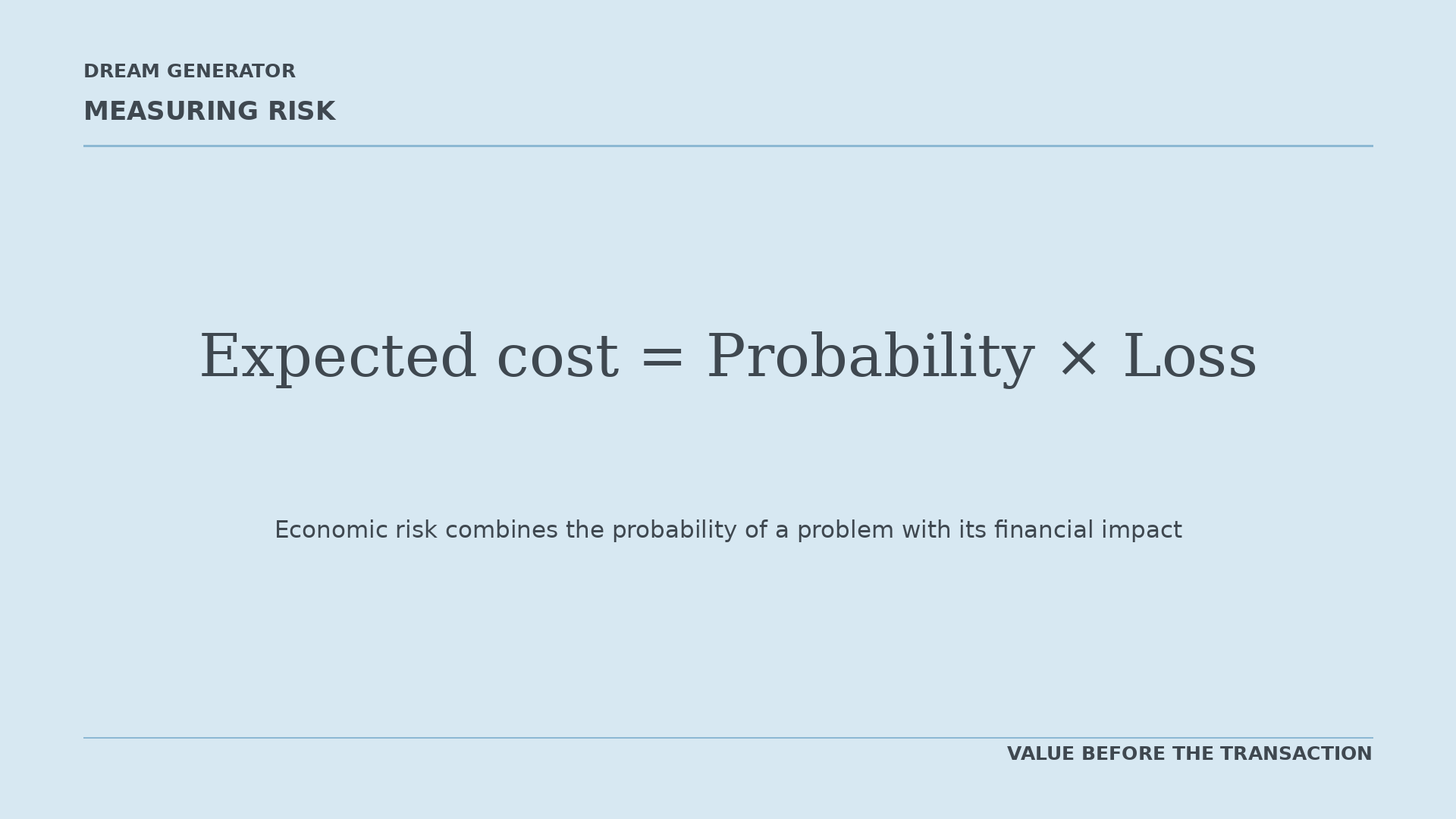
Suppose there is a 25% probability of unexpected works costing €1,500,000.
25% × €1,500,000 = €375,000
The expected cost of the risk is therefore €375,000.
After technical investigations and contractual protections, imagine that the remaining probability falls to 5%:
5% × €1,500,000 = €75,000
The reduction in expected risk would be:
€375,000 − €75,000 = €300,000
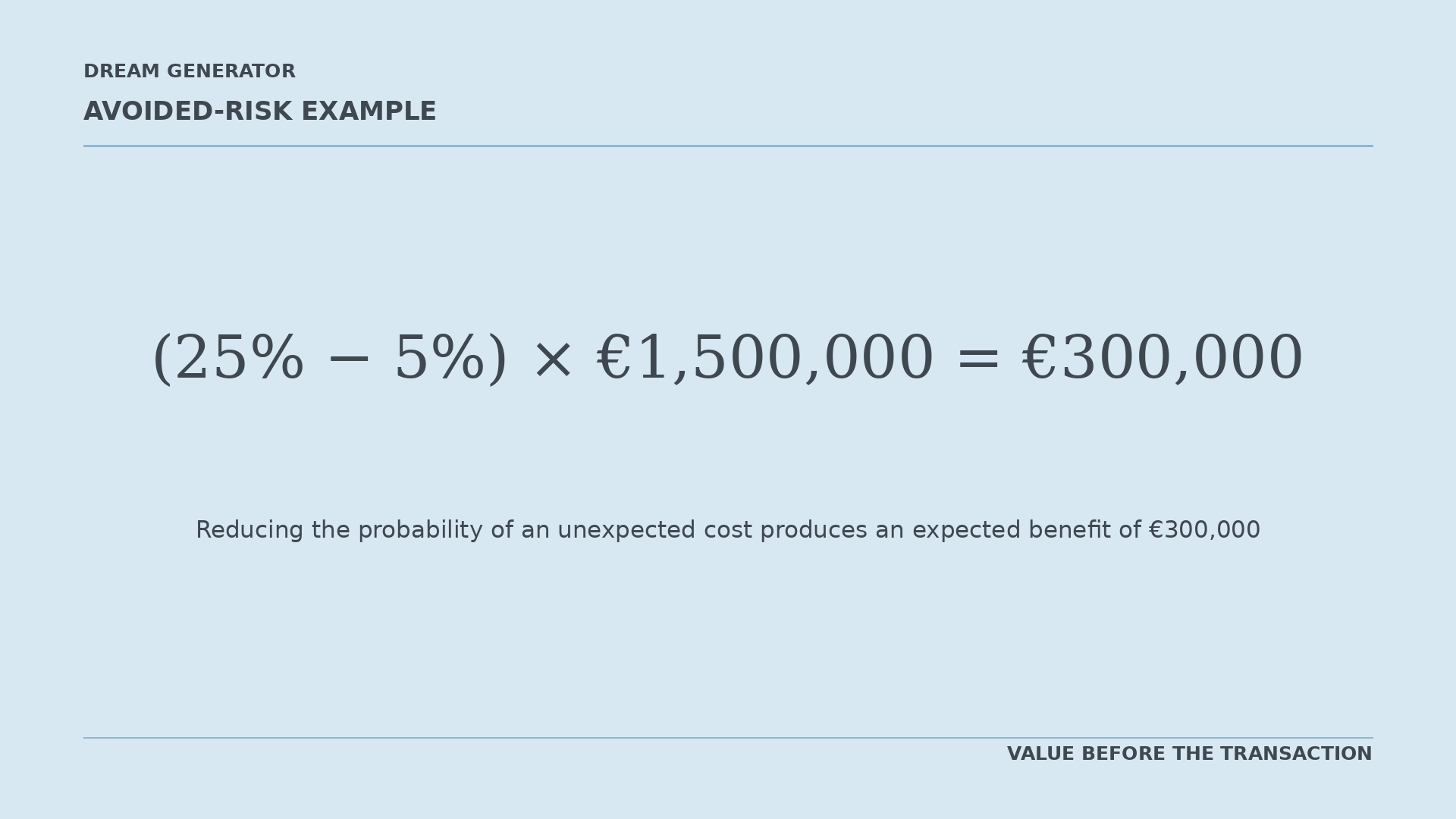
The value produced for the buyer is not necessarily cash received immediately. It is a probable loss that has been reduced or avoided.
A complete example for the buyer
Imagine that the preliminary analysis produces the following results:
- overpayment avoided: €800,000;
- reduction in the risk of unexpected works: €300,000;
- financing and operating costs caused by delays avoided: €350,000;
- cost of due diligence and advice: €150,000.
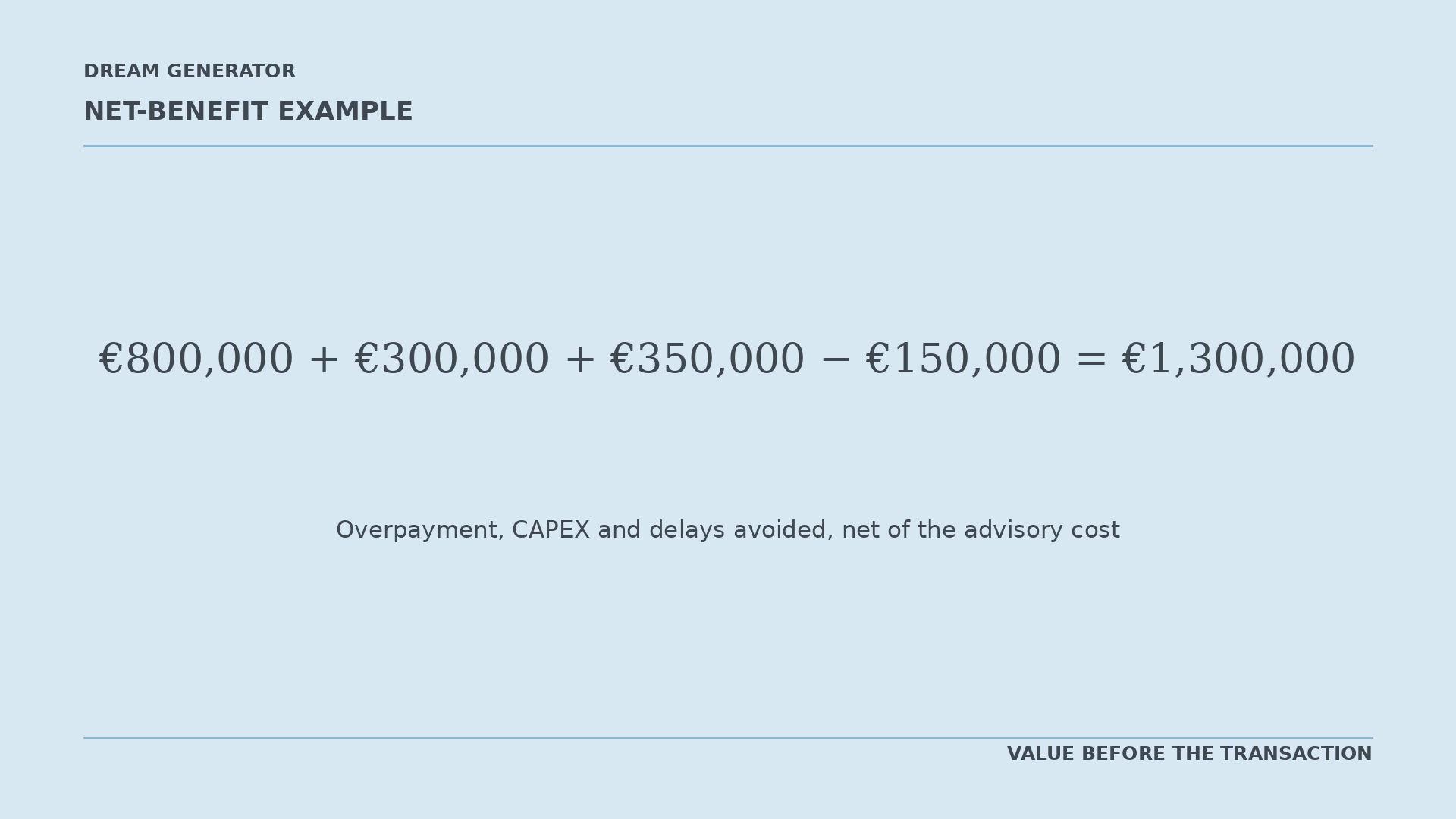
The expected net benefit would be €1,300,000.
This remains an illustrative example. In a real transaction, the probabilities and amounts must be estimated using the specific characteristics of the property and the available evidence.
Preparation does not mean hiding problems
Preparing an asset does not mean making it appear artificially more attractive or concealing its weaknesses.
It means identifying problems before the other party discovers them.
A known defect can be:
- corrected;
- measured;
- explained;
- reflected in the price;
- covered by a warranty;
- allocated through the contract;
- included in the works programme.
A defect discovered late often becomes a negotiating instrument.
The important difference is not whether a problem exists. It is whether the parties understand it and can manage it.
How the result can be measured scientifically
Comparing the asking price with the final price is not enough.
The asking price may have been unrealistic from the beginning.
A serious assessment requires a starting position, or baseline, which can be compared with the actual result.
Before the preparation begins, the following information should be recorded:
- estimated value;
- quality and completeness of documentation;
- NOI and other financial information;
- works expected;
- estimated time required for the sale;
- categories of potentially suitable investors;
- principal known risks;
- the seller’s original conditions.
After the transaction, the following should be measured:
- final price;
- time required to receive a binding offer;
- time required to complete the sale;
- price reductions requested;
- number and quality of offers;
- conditions precedent;
- actual transaction costs;
- actual CAPEX incurred by the buyer;
- difference between expected and realised profitability.
The result should also be compared with properties that are similar in type, location, value and period of sale.
This comparison is called a counterfactual analysis. It tries to estimate what would probably have happened if the preliminary preparation had not been carried out.
Research on due diligence and the “outside view” shows the importance of comparing internal forecasts with external data and comparable cases. This helps reduce the risk of overly optimistic initial estimates.
The role of data
After a sufficient number of transactions, the information can be organised by:
- property category;
- geographical market;
- value range;
- use;
- initial level of preparation;
- technical complexity;
- buyer type;
- transaction duration.
Dream Generator can gradually develop proprietary indicators relating to:
- average and median sale times;
- price reductions;
- differences between initial and final prices;
- recurring risks;
- errors in CAPEX forecasts;
- reasons for failed negotiations;
- the effect of document completeness;
- the behaviour of different investor categories.
Future conclusions should be expressed through ranges and probabilities, not absolute promises.
For example, it may eventually be possible to say:
In comparable cases, complete preparation was associated with a median reduction in transaction time of between X and Y months.
It would not be correct to say:
Preparation always increases the price by 10%.
Value begins before the sale
The final price of a property does not depend only on location, size or general market conditions.
It also depends on the quality of the available information, the credibility of the financial assumptions, the selection of investors, the management of risk and the organisation of the transaction process.
For the seller, preparation may mean:
- a stronger basis for supporting the price;
- a shorter sale process;
- lower holding costs;
- fewer concessions during negotiations;
- more favourable contractual terms;
- a lower probability of transaction failure.
For the buyer, it may mean:
- a price that is more consistent with value;
- more reliable information;
- better forecasting of works;
- lower exposure to unexpected costs;
- more realistic implementation times;
- greater confidence in the investment decision.
Preliminary preparation does not guarantee that a property will sell more quickly or at a higher price.
It allows the parties to make better decisions and reduces the distance between expectations and actual results.
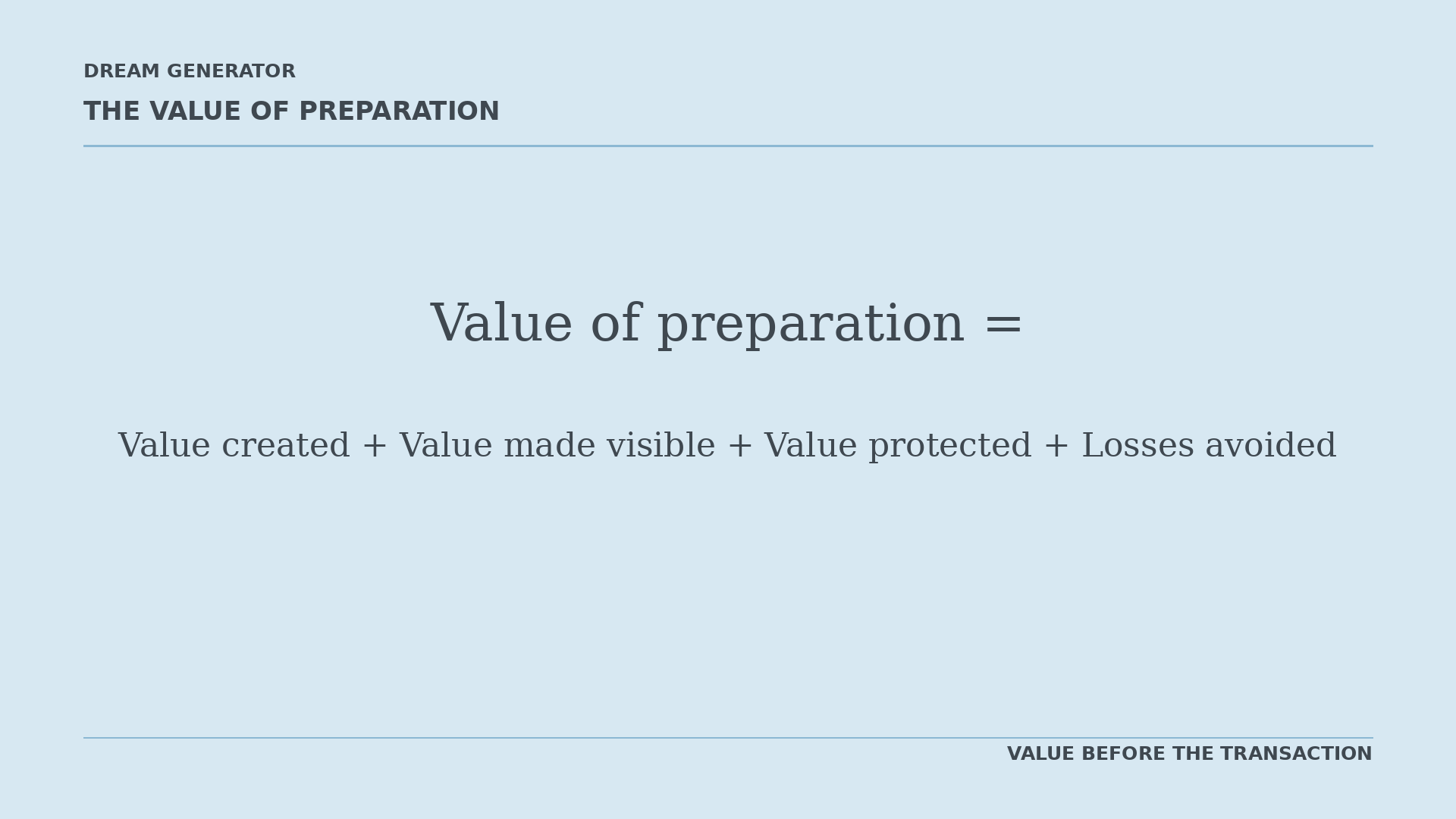
A significant asset can therefore begin to create or lose value long before the contract is signed.
It is during this preliminary phase that analysis, information, positioning and coordination can make the difference between a property that is simply offered to the market and an opportunity that is understood, verified and correctly negotiated.
Methodological note
The figures and percentages used in this article are illustrative examples only.
They do not represent guaranteed returns, price increases or savings. Every asset requires a specific assessment based on verifiable data, market conditions and appropriate professional advice.
Sources and further reading
- Real Estate Strategy
- Asset Preparation
- Valuation
- Due Diligence
- Net Operating Income
- Risk Management

Dream Generator
Start a Conversation
For a considered discussion of the themes examined in this publication, or of a specific international real estate mandate, our advisers are available on a confidential basis.